
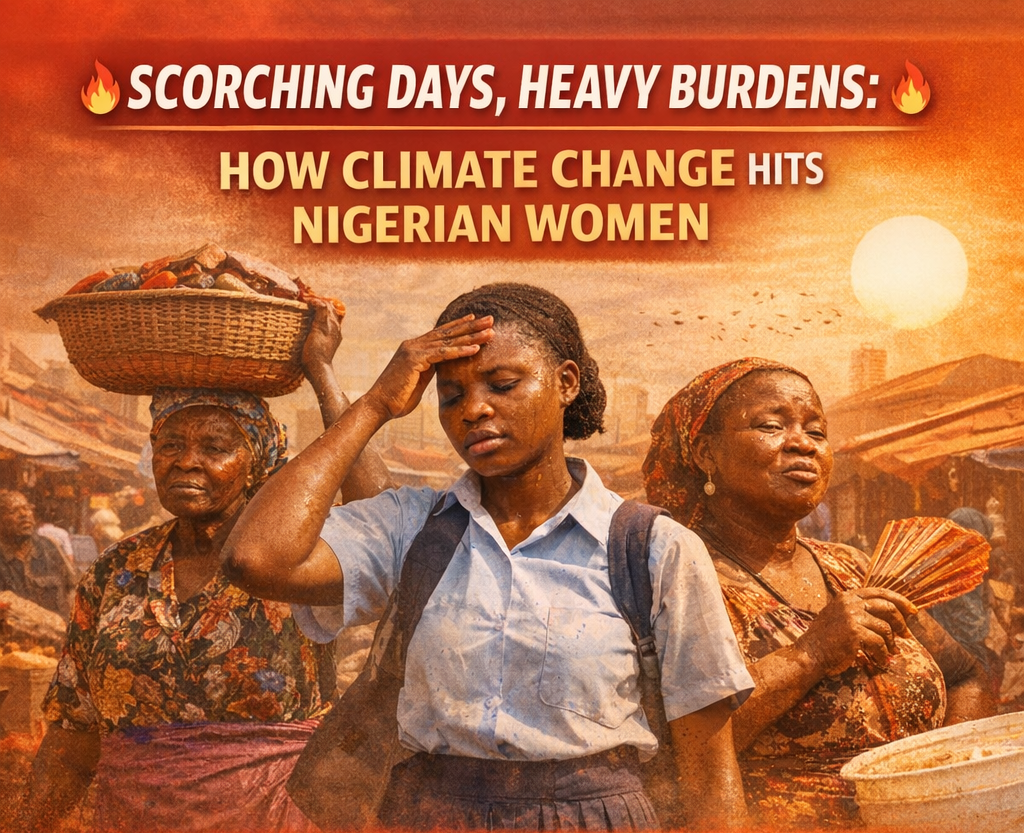
In Lagos and across southwest Nigeria, the morning sun rises relentlessly, casting golden heat across streets, markets, and farmlands. Women of all ages and social classes step into the day carrying responsibilities that the heat amplifies. A young girl walks barefoot to fetch water for her family, careful not to trip on the dusty paths. A mother balances baskets of vegetables on her head in the market, fanning herself with a folded piece of cardboard while customers avoid the mid-morning sun. An elderly grandmother tends her small garden in the city, whispering prayers that her crops will survive another scorched day. Even office workers feel the heat creeping through poorly ventilated buildings, where the hum of fans and the cost of electricity cannot fully relieve the pressure. Across cities and rural communities, the rising temperatures and increasingly erratic weather do more than make life uncomfortable as they disrupt livelihoods, strain health, and test the resilience of women who continue to sustain families, neighborhoods, and local economies with quiet determination.
Climate change is more than rising mercury readings. It represents long-term shifts in weather patterns caused largely by human activities, such as burning fossil fuels, deforestation, and industrial growth, that trap heat in the atmosphere. For southwest Nigeria, this manifests in longer and more intense heat waves, erratic rainfall that disrupts planting seasons, coastal erosion, and even the gradual loss of productive farmland. These environmental shifts create a cascade of challenges known collectively as climate issues that women experience firsthand in both the visible and invisible labor they perform every day. Household management, agricultural work, market trade, caregiving, and small-scale entrepreneurship are all essential roles that are impacted by the new climate reality.
The burden of heat is felt differently across social classes and age groups, but its effects ripple through every community. Women in rural agriculture spend long hours in direct sunlight, tending crops vulnerable to droughts or sudden storms, and often shoulder additional chores like collecting water, fetching firewood, and preparing meals. Market women in urban centers face oppressive heat without adequate shade, water, or rest, reducing both productivity and income. Elderly women, already at risk of dehydration and cardiovascular stress, find the extreme temperatures exacerbate pre-existing health conditions. Meanwhile, young girls and students navigate schools without proper ventilation or access to drinking water, sometimes forced to miss classes or abandon education altogether. Across all these roles and circumstances, women bear a disproportionate share of climate impacts, while their labor sustains entire households and communities.
Heat and climate disruptions also interact with socio-economic factors, making daily survival increasingly difficult. Erratic rainfall can destroy crops and livestock, while flooding and coastal erosion threaten homes and community infrastructure. Women are often at the center of these crises, responsible for securing food and water, caring for the sick, and maintaining family cohesion under extraordinary pressure. These challenges are compounded by limited access to resources, financial services, education, and decision-making spaces. The result is a cycle in which women must work harder, longer, and under more dangerous conditions just to maintain basic stability for their families and communities.
Yet, amid these challenges, women are not passive victims. Across southwest Nigeria, they are leading local solutions that turn vulnerability into resilience. In rural areas, women adopt climate-smart agricultural practices, using drought-resistant seeds, small-scale irrigation, and crop rotation to safeguard food production and improve yields. In urban centers, some community groups establish shaded markets, distribute water, and launch public awareness campaigns about heat stress. Women are increasingly engaging in advocacy, ensuring that community experiences inform policy and planning. They teach each other techniques to adapt to unpredictable weather, share knowledge on sustainable livelihoods, and create networks that empower others to withstand climate shocks. These grassroots efforts demonstrate that climate action is not an abstract concept, it is lived, breathed, and embodied in the everyday work of women who refuse to yield to the heat or the hardships it brings (guardian.ng).
Climate justice goes hand-in-hand with climate action. It is not enough to mitigate heat or prevent flooding; solutions must be equitable and inclusive. Women, particularly those most vulnerable due to age, social class, or rural residence, must have access to resources, decision-making, and support networks that allow them to thrive rather than merely survive. When women are equipped with education, financial tools, and a voice in community planning, their impact multiplies. They become leaders, innovators, and mentors, teaching younger generations about resilience, sustainability, and equity.
The reality of climate change in Lagos and across southwest Nigeria is visible in every market, classroom, and farmland. It shapes how women organize their days, plan for the future, and safeguard the well-being of those around them. By centering women in climate action and climate justice efforts through resource provision, education, infrastructure, and policy, Nigeria can transform these challenges into opportunities for leadership, community resilience, and national progress. Climate change may continue to test the limits of endurance, but when women rise to meet it, entire communities and the nation rise with them.
Take Action Today
Climate change is not a distant threat; it is here, shaping the lives of women, families, and communities across Nigeria. You can be part of the solution. Support grassroots initiatives that empower women in agriculture, urban resilience, and climate advocacy. Share knowledge, amplify women’s voices, and advocate for policies that prioritize equity and climate justice.
Every action counts. Every voice matters. Start by staying informed, supporting women-led projects, and spreading awareness about climate change in your community. Together, we can turn scorching days into opportunities for resilience, equality, and lasting change.