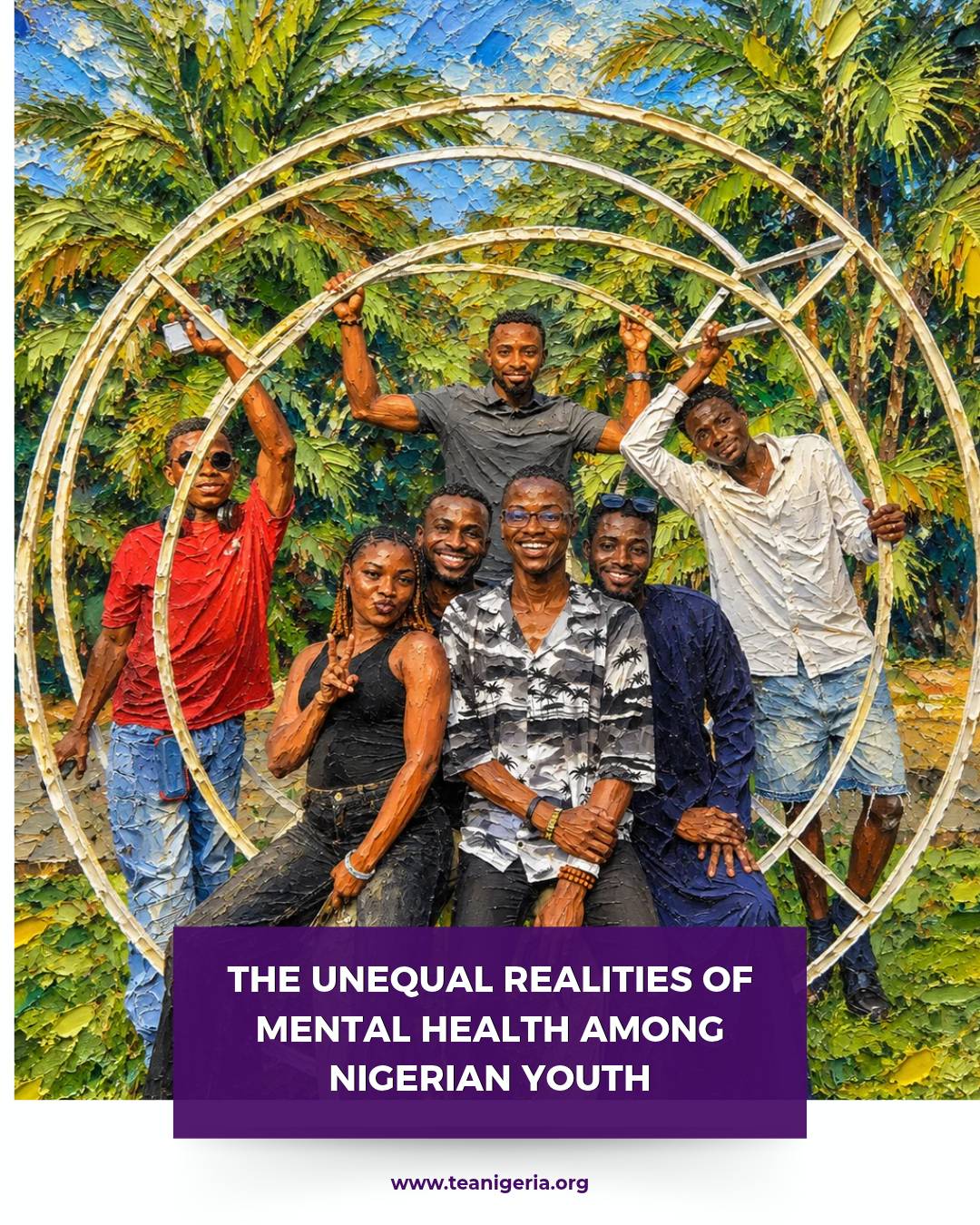
On 10 October, we gathered for a wellness picnic to mark World Mental Health Day. Well-being, we said, is worth an afternoon. But for many young Nigerians, help is much further away than a park.
It was a good afternoon. It also left us with an uncomfortable question. Who wasn’t there? Think of the young person who couldn’t afford the transport, the one stuck at work, the one living in a hostile environment/harsh condition, the one whose family would never allow it. A picnic can start a conversation, but it cannot reach everyone. And for many young Nigerians, the help they need is far further away than a park.
The decade that decides everything
A review of the evidence on Nigerian emerging adults found high rates of psychiatric disorders alongside extremely low use of mental health services [Ajike et al., University of Essex, 2022]. But this gap does not fall evenly. The more a young adult already carries, whether money worries, a disability, displacement, or distance from a clinic, the heavier the load and the farther the help. Young adulthood is a period of role changes and identity formation, which researchers say raises the risk of depression [Meta-analysis of depression among Nigerian higher-education students]. That review of studies on Nigerian university students found depression in about one in four [same meta-analysis]. Research on young adults across all six geopolitical regions also found that suicidal behaviour was linked to dissatisfaction with life, anxiety, drug use, and low self-esteem [Opakunle et al., Taiwanese Journal of Psychiatry, 2021].
Between 18 and 40, almost everything gets decided: where you study, whether you find stable work, whom you build a life with, whom you support, and whether you stay or leave. It is also the stage of life when mental health problems often emerge, and when help is hardest to reach.
The barriers everyone meets
Some obstacles cut across every group. There are too few professionals: Nigeria has about 300 psychiatrists for 206 million people [Everand]. This crushing deficit is worsened by an ongoing “japa” brain drain, as overworked medical specialists continuously leave the country for better opportunities abroad. The few specialists who remain are heavily concentrated in urban centers and a handful of Federal neuropsychiatric hospitals, leaving rural communities almost entirely cut off from formal care. Care is also prohibitively expensive, and most Nigerians pay for it out of their own pockets [The News Nigeria]. Mental health is historically underfunded, usually receiving less than 4% of an already strained national health budget. Because the National Health Insurance Authority (NHIA) framework does not explicitly incorporate or fully cover comprehensive psychiatric treatment, fewer than 3% of Nigerians with mental health conditions have any insurance coverage. For the vast majority, a single mental health crisis threatens catastrophic financial ruin.
And stigma, often tangled up with spiritual belief, keeps many people quiet. Counselling providers at a university in South-West Nigeria reported that seeing mental illness as a supernatural attack discouraged students from asking for help [Dada, Abilene Christian University, 2026]. When emotional distress is mislabeled as a spiritual failing or demonic possession, families hide their suffering to avoid societal rejection. None of these barriers belongs to one region, one community, or one faith. From the systemic lack of infrastructure to the deeply rooted social silence, these hurdles are national, and they are shared.
Knowing the door exists is not the same as walking through it
It is tempting to think young adults stay away because they don’t know help exists. The evidence suggests otherwise. In a study of University of Lagos undergraduates, most had good knowledge of mental health services and a positive attitude toward them, yet fewer than a quarter actually used them well [University of Lagos study, Population Medicine]. Fear of gossip, worries about confidentiality, cost, and distance stand between a young person and help they already know about. Awareness campaigns matter, and the picnic was one in its own way. But awareness is where the work starts, not where it ends.
“Knowing where the door is doesn’t help if it’s locked.”
When the pay doesn’t cover the pressure
Experts say economic hardship creates a constant state of stress, particularly for young people who still depend on their families [The Guardian Nigeria]. Staff at a neuropsychiatric hospital in Abeokuta describe a rising number of young adults seeking help, which they link to economic hardship and trauma [ThisDay]. Much of the strain comes from the kind of work available. The vast majority of jobs in Nigeria are informal [The Guardian Nigeria, citing NBS], which often means no sick leave, no benefits and no safety net.
Even those with steady jobs are feeling it. Surveys of Nigerian employees point to widespread burnout, with workers aged 18 to 35 and women among the hardest hit [BusinessDay, BettaLife survey; Guardian Nigeria, WellNewMe survey]. These are industry surveys rather than clinical studies, but they match what hospital staff report.
“You can work every day and still not be secure.”
The quiet strain behind substance use
A national survey found that drug use was highest among people aged 25 to 39, and that many who wanted treatment could not get it, mainly because of cost and stigma [NBS, Drug Use in Nigeria 2018]. The survey is several years old, but the pattern still matters. Substance use is a health condition, and treating it only as a crime pushes people further from the care they need.
Substance use is another important but often misunderstood dimension of mental health among Nigerian youth. Conversations about drug use frequently focus on arrests, criminality, and moral judgment, with little attention given to the circumstances that may lead young people to use substances or the barriers they face when seeking help. Nigeria’s 2018 National Survey on Drug Use and Health, conducted by the National Bureau of Statistics and the United Nations Office on Drugs and Crime, estimated that 14.3 million Nigerians aged 15–64 had used psychoactive substances in the preceding year, with the highest prevalence recorded among those aged 25–39. The survey also revealed a significant treatment gap: many people who wanted help could not access it, particularly because of the cost of treatment, stigma and limited availability of services. Although these findings are several years old, they remain an important indication of the challenges surrounding substance use and treatment in Nigeria. For some young people, substance use may begin through curiosity, peer influence or social pressure; for others, it may become entangled with unemployment, family conflict, trauma, anxiety, depression or attempts to cope with emotional distress. This does not mean that every person who uses substances has a mental health condition, but it reinforces the need to understand substance use as a complex public health issue rather than dismissing everyone involved as irresponsible or morally deficient.
The inequalities become more evident when we consider who can afford treatment and who is left without support. A young person from a financially stable household may be able to access professional assessment, counselling or rehabilitation, while someone from a low-income community may have no affordable treatment facility within reach. Young women who use drugs may face additional stigma, fear of judgment, violence and barriers linked to pregnancy or caregiving responsibilities. In some communities, substances may be easier to obtain than confidential, professional support. When people fear arrest, public humiliation or rejection, they may avoid seeking help until their circumstances become more severe. Law enforcement has a legitimate role in addressing drug trafficking and illegal supply, but people experiencing substance-related health problems also need evidence-based treatment, dignity and opportunities for recovery. Nigeria must therefore strengthen affordable community-based services, integrate substance use treatment into mental healthcare, train healthcare workers and ensure that young people can seek help without being automatically treated as criminals. Recovery should not be a privilege reserved for those who can afford it, and the need for treatment should never be overshadowed by stigma or punishment.
Women, mothers and a double burden
Women often carry strain on several fronts. Research on postnatal women in Enugu found high levels of depressive and anxiety symptoms and called for care that is affordable and reaches poor and rural women [Enugu postnatal study]. Workplace surveys report slightly higher burnout risk among women [Guardian Nigeria, WellNewMe survey]. And for women with disabilities, research found discrimination on two fronts at once, as women and as people with disabilities [ICED and Mastercard Foundation, 2023].
Displaced, disabled and far from help
Some young adults face several barriers at once. For people forced from their homes, the loss is more than a building. Studies of adults in a Kaduna camp found high rates of post-traumatic stress [Frontiers in Psychiatry, 2016, citing earlier research]. Losing a home, an income and a community removes the supports that protect mental health, and services rarely reach the camps. For young people with disabilities, research found that most struggled to find work and met discriminatory attitudes [ICED and Mastercard Foundation, 2023]. And for those who live far from towns, a review of the Mental Health Act highlighted the urban-rural gap in access to facilities and the shortage of doctors [West African Journal of Medicine].
“A clinic two hours away is not a clinic.”
None of this is the story of one region or one group. Relatively advantaged young adults also face burnout, isolation and stigma. But when a young person is poor, displaced, disabled or rural, each barrier stacks on the last.
The promise on paper
The National Mental Health Act 2021 promises care that is affordable, accessible and fairly distributed [National Mental Health Act 2021]. Nearly four years on, a leading psychiatrist says the Department of Mental Health Services it requires has still not been set up [PM Parrot], and less than 3 per cent of the health budget goes to mental health [Nigeria Health Times]. For a young adult, the question is simple: does the law reach me?
The National Mental Health Act, 2021 (No. 46) of Nigeria is a comprehensive legislation enacted on 28th December 2022 to establish the Mental Health Services Department, promote and protect the rights of persons with intellectual, psychosocial, or cognitive disabilities, and regulate mental health services in the country. The Act is structured into five parts and includes 58 sections.
Part I outlines objectives, coordination, and administration, including the establishment of the Mental Health Services Department, its objectives, powers, functions, the Mental Health Fund, and the Mental Health Assessment Committee. Part II details the rights of persons with mental health conditions, covering employment, housing, access to services, quality treatment, legal representation, participation in treatment, privacy, confidentiality, and protection from discrimination. Part III focuses on facility-based treatment, including establishment of facilities, treatment programmes, informed consent, voluntary and involuntary admission, conditions for restraint or seclusion, prohibition of sterilization, regulation of electroconvulsive therapy and psychosurgery, clinical research, protection of children, support for carers, removal to a place of safety, leave, discharge, and handling of non-accredited facilities. Part IV addresses persons with mental health conditions involved in criminal proceedings, including admission of criminal patients, compulsory orders with restrictions, and removal of inmates to hospital. Part V covers property and affairs of persons with mental health conditions, emergency powers of judges, violations, refusal to supply information, forgery, assisting unlawful absence, sexual relationships with patients, limitation of suits, interpretation, and citation. The Act also includes a schedule. Key entities include the Mental Health Services Department, the Mental Health Fund, and the Mental Health Assessment Committee. The document is a policy/act of the Nigerian government.
Mental health care should fit our culture, cost less, be close to people, and be shared fairly across the country. The Act talks about every person in Nigeria [National Mental Health Act 2021]. It also sets up three things: a Department of Mental Health Services, a Mental Health Fund and a Mental Health Assessment Committee [The News Nigeria]. And it bans unfair treatment in housing, jobs and health care [Nigerian Medical Journal].
Every person includes young people. Still, a promise for everyone isn’t a plan for anyone in particular.
What a fairer system would look like
Fairness starts with knowing who is struggling, so government needs reliable data on young adults, including those in rural areas, camps and informal settlements. It needs to bring care closer by training primary health care workers to spot common conditions early [NAN News], and to bring mental health within reach of insurance so that cost is not the deciding factor.
Universities can do more than hope students find their way. A 2026 study called for routine mental health screening in tertiary institutions [Kato et al., 2026], and a pilot at the University of Ibadan showed that training student volunteers as peer counsellors is feasible [Ekore et al., University of Ibadan]. Employers can treat burnout as the workplace risk it is. And communities can do what a picnic does at its best: make it normal to ask “How are you really?” and to listen to the answer.
From one afternoon to every day
The picnic on 10 October was one afternoon. The goal is every day, for every young person, wherever they live and whatever they earn. That will not happen through awareness alone. It will take data, funding, trained people and care that is close enough to reach.
So check in on the friend who always says they’re fine. Ask your employer or school what mental health support exists, and what it would take to improve it. Share this article with someone in health, education, human resources or government. And support the youth-led organisations already doing this work with very little.
Every young adult in Nigeria deserves a door. Our job is to make sure it opens.
If you’re struggling
You are not weak, and you are not alone. If you are struggling and could use someone to talk to, reach out to a friend, a family member, a counsellor or a health worker you trust.
If you are in danger right now, call emergency services or go to the nearest health facility.
you can also click here to access our linkage/referral form.
Mental health month is over,  but the work isn't.
The picnic was a day but the movement is every day, will you be part of it?
                                                                                                          - @tea_nigeria