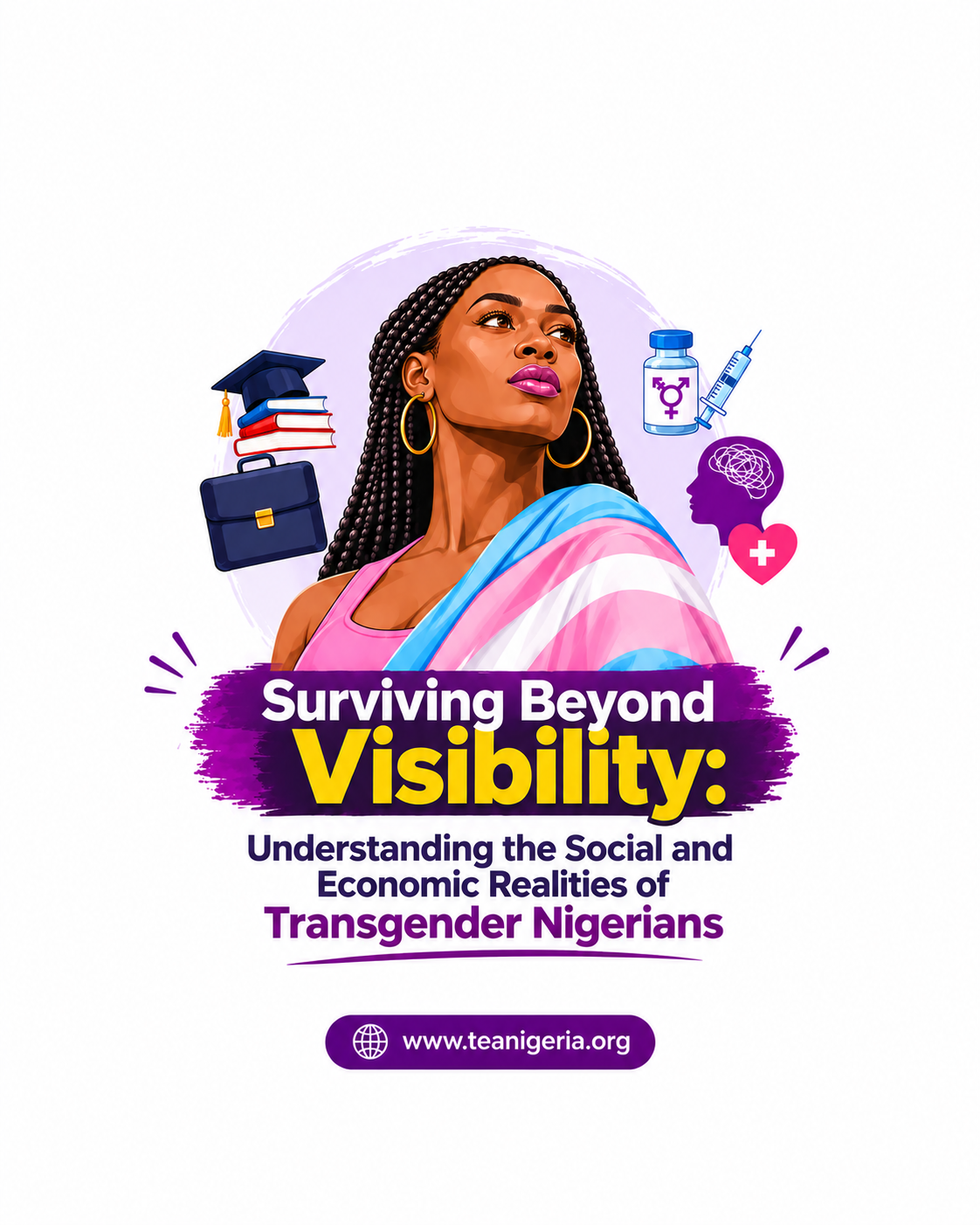
This November, as we commemorate Transgender Awareness Month, we turn our attention beyond visibility to the realities of survival, economic independence, dignity, and the right to live without exclusion.
There are people who spend the night wondering where they will sleep. Others wake up uncertain whether they will still have a job, a home, or access to the medication they depend on. Some have learned to keep their identities private, not because they are ashamed of who they are, but because being discovered could cost them their accommodation, livelihood, safety, or relationships. For others, even walking into a public space can become an experience of anxiety, humiliation, and unwanted attention.These are some of the realities that exist behind the conversations about transgender visibility in Nigeria.
Every November, Transgender Awareness Month provides an opportunity to recognize transgender people, celebrate their identities, acknowledge their contributions, and reflect on the discrimination they continue to experience. Yet, beyond awareness campaigns, public statements, and messages of solidarity, there is a much more difficult conversation that deserves attention. What happens to transgender Nigerians when the celebrations are over? What happens when someone who has been celebrated online returns to a home where they are not accepted, a workplace where their identity is questioned, or a community where their existence is treated as an offence?
For many, the struggle is not simply about being recognized. It is about having somewhere safe to live, being able to afford food, accessing healthcare without humiliation, securing an education, finding sustainable employment, and having the freedom to move through society without fear of violence.
The circumstances are particularly difficult for those experiencing poverty, family rejection, homelessness, and limited access to social support. When several of these challenges occur together, survival can become an exhausting daily responsibility. This is why understanding transgender experiences requires more than acknowledging identity. It requires examining the economic, social, institutional, and environmental conditions that determine whether people can live with dignity.
When Being Seen Becomes a Risk: Violence, Humiliation and the Denial of Human Dignity
For some transgender Nigerians, the experience of being recognized is not always accompanied by acceptance. Sometimes, it becomes the beginning of public humiliation, harassment, intimidation, or physical violence. A person’s appearance, voice, clothing, name, or gender expression can become grounds for unwanted interrogation and scrutiny. In particularly disturbing situations, individuals have been subjected to demands to undress so that others can supposedly establish their sex. What should be a private matter concerning bodily autonomy becomes an opportunity for humiliation.
Imagine being stopped at a security checkpoint or confronted in a public place, not because you have committed an offence, but because someone has decided that your appearance does not conform to their expectations of what a man or woman should look like. Imagine being ordered to remove your clothes while strangers watch, photograph you, or question your identity. Beyond the immediate humiliation, there is the possibility that those images may circulate on social media, exposing you to further harassment, blackmail, ridicule, or threats. These are not merely uncomfortable encounters. They are violations of personal dignity, bodily autonomy, and privacy.
This is not an imagined concern without documented precedent. A 2025 UK Home Office country information report on Nigeria documented violence, harassment, and discriminatory treatment affecting LGBT+ people, including transgender people. It also referenced cases of transgender people experiencing assault and threats. In a particularly disturbing account, a Nigerian transgender woman was reportedly assaulted and forced to transfer money to her attacker. The same report documented the case of a transgender woman who fled her home after online hostility began manifesting physically. https://www.gov.uk/government/publications/nigeria-country-policy-and-information-notes/country-policy-and-information-note-sexual-orientation-gender-identity-and-expression-and-sex-characteristics-nigeria-june-2025
There have also been documented incidents involving public humiliation and forced undressing of people perceived to be gender nonconforming. In April 2024, Nigeria’s National Human Rights Commission condemned a widely circulated incident in which a person was ordered to strip naked in front of security operatives. The Commission described the treatment as degrading and called on law enforcement agencies to desist from such conduct. https://www.nhrc.gov.ng/nhrc-media/news-and-events/469-cross-dresser-ordered-to-strip-self-nhrc-condemns-degrading-treatment-in-all-ramifications.html
Beyond public harassment, some transgender people encounter hostility within their families and religious or social environments. Their identities may be described as demonic, unnatural, possessed, or evidence of spiritual affliction. In some situations, these beliefs are used to justify coercive religious interventions, forced confinement, beatings, isolation, and attempts to change how an individual expresses their gender. What is presented as spiritual correction can become a deeply harmful experience that strips people of their autonomy and sense of belonging.
For a young person who depends financially on their family, such rejection can be especially devastating. They may be forced to leave home, lose access to education, or find themselves without the resources needed to establish an independent life. The emotional consequences can extend well beyond the immediate incident. Living with the possibility of being exposed, ridiculed, attacked, or rejected can create persistent fear, anxiety, isolation, and psychological distress.
Transgender men experience their own distinct forms of scrutiny. Some encounter ridicule, threats, misgendering, and questions about their bodies, particularly in environments where people insist on interpreting their identity through assumptions about their sex assigned at birth. Transgender women may face heightened public scrutiny because of their gender expression, with some experiencing harassment, physical attacks, and attempts to expose or challenge their bodies. Nonbinary and other gender-diverse individuals may face additional difficulties when institutions and communities insist that everyone must fit neatly into categories of male or female.
These experiences should not be collapsed into a single narrative. However, they reveal a shared concern: the right to exist without having one’s body, identity, or dignity subjected to public inspection and punishment.
The 2024 killing of Nigerian transgender woman and online personality Abuja Area Mama brought this reality into painful public focus. Her beaten body was found along a highway in Abuja in August 2024. She had previously spoken about attacks and fears for her safety. Her death was a devastating reminder of the physical dangers that can confront transgender people. https://www.bbc.com/news/world-africa-45169608
A person’s body is not public property. Their identity is not an invitation to humiliation, and their existence is not an offence that requires public punishment.
– Jax Oud
Poverty, Housing Insecurity and the Economy of Survival: When Having Nowhere to Go Becomes Another Vulnerability
One of the most difficult realities facing some transgender Nigerians is the struggle to secure and maintain safe accommodation. For people already experiencing economic hardship, losing a home can become the beginning of a much more complicated crisis. Consider someone who has saved for months to pay rent, moved into a new apartment, and begun establishing a routine. Their landlord later discovers their transgender identity, perhaps through personal disclosure, information from a neighbor, an encounter with visitors, or an invasion of their privacy. Suddenly, the relationship changes. They begin receiving uncomfortable questions, threats, restrictions, or demands to leave the property. In some situations, the landlord may refuse to renew the tenancy or attempt to force the person out despite having received payment.
The financial implications can be severe. Finding another apartment requires money for rent, agency fees, legal documentation, transportation, and other expenses. Someone who has already exhausted their savings may have no immediate alternative. Some are forced to move between friends’ homes, depend on temporary arrangements, sleep in unsafe locations, or spend nights wherever they can find temporary shelter. Others may find themselves moving repeatedly because the people offering accommodation eventually become uncomfortable with their identity or fear the reactions of neighbors and landlords.
A home should provide security, privacy, and a place to recover from the pressures of everyday life. Yet, for someone experiencing repeated displacement, even the meaning of home can become uncertain. This concern is reflected in the UK Home Office’s 2025 Nigeria country information report, which documented housing discrimination against LGBTQI+ people, including denial of accommodation and eviction after landlords or neighbors became aware of their identities. The report also referenced a 2024 CHEVS/TIERs study in which 14 of 89 respondents, or 15.7%, reported experiencing at least one form of discrimination in securing housing based on their sexual orientation, gender identity, gender expression, or sex characteristics. Importantly, this was a broader SOGIESC sample and should not be interpreted as a transgender-only statistic. https://www.gov.uk/government/publications/nigeria-country-policy-and-information-notes/country-policy-and-information-note-sexual-orientation-gender-identity-and-expression-and-sex-characteristics-nigeria-june-2025
Housing insecurity is closely connected to employment and poverty. A person without stable accommodation may struggle to maintain a job, attend classes, keep appointments, store personal belongings, or access consistent healthcare. When accommodation is lost, the individual may also lose access to the social relationships and support systems that previously helped them manage everyday life. The situation becomes even more complicated when employment opportunities are limited. Some transgender people have the qualifications and skills required to work but encounter rejection because of their appearance, gender expression, or documentation. Others are unable to secure formal employment and depend on informal activities with irregular earnings and little protection against exploitation.
For some, sex work becomes a means of generating income when conventional employment opportunities are inaccessible. Others turn to adult content creation, online entertainment, digital services, or other forms of informal work. It is important not to assume that every transgender person involved in sex work or adult content creation is being coerced. People have agency and make different decisions about their livelihoods. However, we must also acknowledge that poverty, homelessness, family rejection, discrimination, and the absence of alternative income sources can severely restrict the choices available to some individuals.
There is a significant difference between choosing a livelihood from a position of financial independence and entering a situation because there are few realistic alternatives for meeting basic needs. Where economic desperation is combined with manipulation, threats, debt, violence, or exploitation, the risks become even greater.
The experiences of transgender women in particular deserve attention in this conversation. The UK Home Office’s country information report notes that some transgender women in Nigeria have turned to prostitution in the context of discrimination and difficulties accessing formal employment, exposing them to further risks of abuse, harassment, and arrest. The life and death of Abuja Area Mama also brought public attention to the vulnerability experienced by some transgender sex workers.
These circumstances should not be used to stigmatize sex workers. Rather, they should prompt a more serious examination of the conditions that determine whether people can access safe, sustainable, and dignified livelihood opportunities.
Poverty also affects transgender people’s ability to access education. A young person who loses family support may be unable to pay tuition, examination fees, accommodation costs, or transportation expenses. Some may interrupt their education to earn an income, while others may abandon their ambitions because the immediate demands of survival have become more pressing.
When someone has nowhere safe to sleep, no reliable source of income, and no support to fall back on, the question is no longer simply how they will progress. It becomes how they will survive the next day.
This is why economic empowerment must be treated as a central part of transgender inclusion. Access to vocational training, education, entrepreneurship support, employment opportunities, emergency accommodation, and social protection can help reduce the conditions that expose people to exploitation and prolonged instability.
Healthcare, Hormones and Mental Health: The Risks of Having to Navigate Your Own Survival
Healthcare is another area where the gap between visibility and lived reality becomes particularly evident. For many transgender Nigerians, accessing appropriate and respectful healthcare can involve financial, institutional, and social difficulties. Some are concerned about being questioned, misgendered, exposed, denied services, or treated with hostility. Others avoid facilities altogether because of previous experiences or fear of how their identities will be received.
These barriers become particularly important when discussing gender-affirming healthcare, including access to hormones.
For transgender people who choose to use hormone therapy as part of their gender affirmation, access to reliable medication, qualified medical guidance, appropriate monitoring, and accurate information is essential. However, where specialized healthcare services are scarce, expensive, or difficult to access, some individuals may turn to informal sources of medication or self-prescription.
This can create additional health concerns. Medication obtained without reliable guidance may be inappropriate, improperly stored, incorrectly dosed, or used without the monitoring needed to identify potential complications. People may also struggle to obtain information about interactions with other medications, appropriate follow-up examinations, and the importance of monitoring their health over time.
The problem is not that transgender people want to access hormones. The problem is that the conditions required for safe and informed access are not equally available to everyone.
The European Union Agency for Asylum’s January 2026 Nigeria Country Focus specifically notes that transgender people may turn to self-prescription because of limited access to specialized medical support. It also documents the wider discrimination and provider bias that affect access to healthcare. https://www.euaa.europa.eu/nigeria-country-focus/25-lgbtiq-individuals
There is also a need to discuss the sharing of syringes and other injection equipment within some communities. This issue requires careful attention rather than assumptions. Not every syringe used by a transgender person is necessarily for hormone administration, and the available evidence does not establish how common syringe sharing for hormones is among transgender Nigerians. Some hormone regimens involve injections, and where sterile equipment is inaccessible or unaffordable, sharing injection equipment can create risks of blood-borne infections, including HIV and hepatitis B and C.
GATE’s 2023 policy brief on trans men and broader health responses highlights the need for access to sterile injection supplies, appropriate information, and harm-reduction services. It also acknowledges that information on needle sharing specifically for hormone use remains limited. Although the brief addresses international evidence rather than establishing the prevalence of this practice in Nigeria, it demonstrates why safe access to injection equipment and gender-affirming healthcare deserves attention.
The conversation should therefore focus on making healthcare safer and more accessible, not shaming people who are trying to manage their health under difficult circumstances.
Mental health is inseparable from these experiences. Imagine constantly worrying about whether medication will be available, whether the next hospital visit will involve humiliation, or whether someone might discover private medical information. Add the pressure of unemployment, housing instability, family rejection, and the experience of being repeatedly questioned about one’s identity. The cumulative emotional burden can become significant.
For transgender men, transgender women, and nonbinary people, the specific pressures may differ, but the need for accessible, respectful, and appropriate mental health services remains important.
There is also a tendency to celebrate resilience without examining what people are being forced to endure. Transgender people are frequently expected to demonstrate strength in circumstances where adequate support is absent. They are encouraged to be courageous, remain hopeful, and continue fighting, even when their immediate needs remain unmet.
Resilience is valuable, but it should never become an excuse for inadequate healthcare, inaccessible medication, or the absence of social support.
People should not have to risk their health simply because safe and affordable healthcare is beyond their reach.
– Jax Oud
A meaningful healthcare response must include respectful providers, accessible hormone-related information, affordable services, mental health support, safe injection supplies where relevant, and referral pathways that do not expose individuals to unnecessary stigma or discrimination.
Climate Vulnerability, Global Economic Pressures and the Shrinking Support Systems Around Transgender Communities
The challenges confronting transgender Nigerians do not exist in isolation from the wider economic and environmental conditions affecting the country. Rising living costs, unstable employment, food insecurity, housing pressures, and the increasing cost of essential services affect millions of Nigerians. However, the ability to withstand these pressures differs considerably depending on an individual’s income, social support, employment security, and access to essential resources.
For transgender people who are already experiencing discrimination and poverty, these economic pressures can compound existing vulnerabilities.
Climate change introduces another important dimension. Flooding, extreme heat, environmental degradation, and disruptions to livelihoods can affect people who depend on informal work, live in poorly serviced neighborhoods, or occupy insecure accommodation. Consider a transgender person who earns a living through trading, daily-paid work, or another informal occupation. A period of severe rainfall could damage their goods, disrupt transportation, affect their rented accommodation, or prevent them from reaching work. A prolonged period of extreme heat may reduce their ability to work outdoors, while unreliable electricity and the cost of alternative cooling arrangements place additional pressure on an already limited income.
For someone with savings, insurance, family support, or access to credit, recovering from such disruptions may be possible. For someone who is already struggling to afford basic necessities, even a few days without income can create a serious financial crisis.
These environmental pressures affect many Nigerians, but their consequences can be especially difficult for people who lack stable housing, savings, or reliable support systems. Climate resilience must therefore be considered alongside economic inclusion, housing security, and access to essential services.
The World Bank’s 2026 Nigeria Country Climate and Development Report highlights the substantial economic risks associated with climate change and the importance of adaptation. The wider implication is clear: environmental shocks can deepen existing economic inequalities when people lack the resources and infrastructure required to recover.
However, there is another crisis that deserves attention: the increasingly difficult funding environment facing organizations, activists, and community-based initiatives working to support marginalized populations.
For many transgender Nigerians, community-based organizations are more than institutions implementing projects. They can be the first point of contact when someone needs mental health support, healthcare referrals, legal assistance, livelihood opportunities, emergency support, or a safe space to discuss their experiences. In situations where formal institutions are inaccessible or unwelcoming, these organizations often provide an important connection to essential services.
But community organizations also need resources to function.
They require trained personnel, operational funding, secure spaces, communication systems, transportation, and the financial capacity to respond to urgent community needs. When funding is reduced, projects may be suspended, staff positions may disappear, outreach activities may become irregular, and referral systems may become difficult to maintain.
The global funding environment has become increasingly challenging for many organizations working on LGBTQI+ rights and community development. Outright International’s 2026 report, Breaking Point, surveyed 229 LGBTIQ organizations across 94 countries and documented significant funding losses among respondents following January 2025. The report also highlighted the consequences for essential community services.
Rainbow Railroad’s 2025 annual report similarly illustrated the gap between demand for grassroots organizational support and the resources available to respond to it.
For organizations in Nigeria, these developments raise important questions about sustainability and the future of community-led support. When a grassroots organization can no longer maintain its activities, the consequences reach beyond its internal operations. Someone who depended on its referral network may lose access to healthcare. A young person who needed livelihood training may miss an opportunity. Someone experiencing displacement may no longer have a reliable organization to approach for assistance.
There is also a need to reconsider how funding opportunities are distributed. Emerging organizations, independent activists, and grassroots initiatives may have fewer institutional resources than established national actors. Yet they are often directly connected to the communities experiencing the challenges being addressed.
Smaller grants, flexible funding, emergency support, and longer-term investments can make a meaningful difference. Funding should not be limited to organizations with the strongest institutional visibility. Individuals, activists, and smaller community-based organizations also need opportunities to demonstrate their work and access the resources required to sustain it.
The work of supporting transgender communities cannot depend indefinitely on the personal sacrifices of activists and volunteers. Community-led interventions require investment, continuity, and recognition.
When the organizations providing support are struggling to survive, the people who depend on those services become even more vulnerable.
This November, the conversation about transgender inclusion must therefore extend to the sustainability of the organizations, activists, and networks working to protect community wellbeing.
Beyond Visibility: What Must Change?
Transgender Awareness Month should be more than a calendar moment when transgender identities receive public recognition. It should be an opportunity to examine the conditions that determine whether transgender people can live safely, independently, and with dignity.
Recognition must be accompanied by action. Access to education must be strengthened. Employment opportunities must become more inclusive. Healthcare must be affordable, respectful, and accessible. People who experience housing discrimination and displacement need support systems that can respond to their immediate needs. Mental health interventions must recognize the cumulative effects of social exclusion and economic insecurity. Climate adaptation and livelihood programs must also consider the realities of people living in vulnerable communities.
There must also be sustained investment in grassroots organizations, independent activists, and community-led initiatives. These actors should not be expected to address complex social challenges without the resources required to do so.
Most importantly, transgender Nigerians must be recognized as individuals with ambitions, abilities, talents, and contributions that extend far beyond the discrimination they experience. They are students, professionals, entrepreneurs, creatives, caregivers, advocates, and community leaders. Their stories should not be reduced to accounts of suffering, nor should their identities be discussed only when there is a crisis.
Their voices, knowledge, and leadership must be part of the conversations and decisions shaping their futures.
As we commemorate Transgender Awareness Month this November, let us recognize those who continue to navigate difficult circumstances while pursuing education, building livelihoods, supporting their communities, and imagining better futures. Let us also acknowledge those who are currently without stable accommodation, those who have been pushed out of educational and employment opportunities, those navigating healthcare barriers, and those who depend on community support to get through difficult periods.
Visibility should open doors.
Awareness should challenge barriers. Inclusion should create opportunities. And dignity should never be something a person has to struggle to earn.